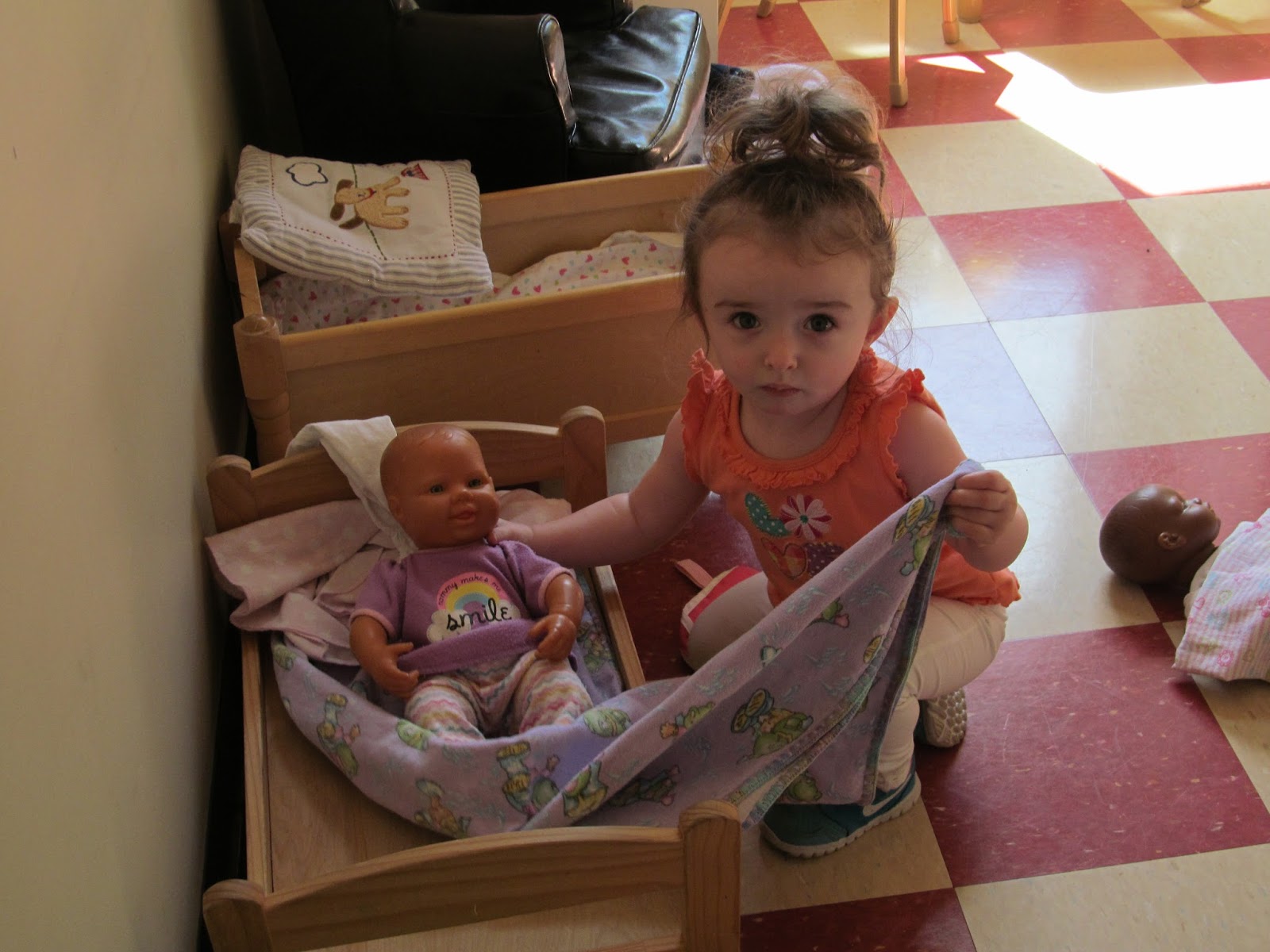
On Thursday, March 17, I spent a few hours with Sophie.
First we were walking up a sidewalk, and she decided this looked like a great place to have a seat.
Later we went to Alamance Crossing's play area where she ran and climbed a bit. Oh, and went through tunnels.
She wanted to check out these things.
And we also saw the water. I think she wanted to get in. It was unseasonably warm for mid-March!
I took her by the children's museum. She started playing with a wheelbarrow in the building room, and suddenly asked about her babies. I think she remembered them from our last visit. I told her to find them so she did.
After some time, we went outside where she enjoyed playing in the sand - and throwing both sand and mulch.
She had it all in her hair.
She had a great time with an almost-three-year old named Eddie.
In fact she followed Eddie into the water. They aren't really supposed to get in there, but sometimes we are rebels.
Sophie made herself this much at home in the water just before I plucked her out so we could leave. I had to change her clothes and take her home for a bath. (Remember that hair?)
Usually the water is cleaner, but it's been "turned off" for the winter and thus got a little ... green.
Fitting for St. Patrick's Day.
Saturday, March 19, 2016
Wednesday, March 2, 2016
February Books
Between Worlds: Essays on Culture and Belonging
by Marilyn R. Gardner -- although she was born in the US to American
parents, the author was on a ship to Pakistan before she was able to
walk. Most of her growing-up years were spent in that country, and this
book explores her thoughts on being back in her "passport country" as
an adult and how she longs for another place. This book began as blog
posts. I think someone shared an article on Facebook and I noticed she
had a book so I put it on my Amazon Wishlist, and got this for Christmas
last year. My grandfather was born in China, and only came to the US
on furloughs every few years. He went to college in the US, but later
left for western Africa as a missionary. My mom was born in Paris, but
left for the Niger region of Africa before she could walk. She didn't
see the US until she was five. So in some ways I tried to understand
some of their thoughts - perhaps. Also I couldn't help thinking of my
Syrian friend who went to Germany with a plan, but didn't realize when
he left that soon his country would erupt in a civil war that threatens
to keep him out for good - or at least that's how it appears now.
I Sleep in Hitler's Room
by Tuvia Tenebom -- I read a book about this Jew's visit to
Israel/Palestine last year. I saw this book about his visit to Germany,
and put it on my wishlist. I liked the other book better, but this was
OK. He gets a little too hung up on German anti-Semitism, in my
opinion, but putting myself in his shoes, I guess it's understandable. I
thought his comment about Germany welcoming in people who also hate
Jews (he regularly mixes hatred of Israel with hatred of Jews, but I
don't think that's totally untrue as I hear many Muslims/Arabs/Persians,
etc. do the same) doesn't bode well for Germany. And this book was
written before the massive influx of hundreds of thousands more
Muslims/Arabs who grow up with that hatred. So ... I do wonder what
Tuvia would say about Germany now.
Over the Hills
by David Lamb -- this is the account of a journalist's ride across the
US in the mid-1990s. He began his trip near his home in northern
Virginia, and traveled to Los Angeles. I enjoyed his account of people
he met, and also of the history of roads and bicycling, and famous
cyclists.
Wait Till Next Year
by Doris Kearns Goodwin -- I found this at a book exchange in Southport
a few months ago. It used to be part of the Islip Public Library in
Islip, New York, and also part of the Rourk Branch Library in Shallotte,
NC. It's made its rounds, I guess. This story dealt a lot with
baseball, and growing up with three New York teams. This author was an
avid fan of the Brooklyn Dodgers, and she told stories of her life
growing up in New York City, and how family life was back in the 1950s.
While baseball isn't my favorite sport by any means, I enjoyed learning
about her life and how national and international events shaped her
life and her community. I may see about reading some of her other
books. This one was a memoir, but she is a historian.
Return to Sullivans Island
by Dorothea Benton Frank -- another book I got in Southport. This one
is about a college grad, Beth Hayes (I have a cousin with this name),
who is house sitting for her family as her mom is away in Paris for a
year, and her aunt is in California. Mostly I thought the book was only
OK... maybe one or two parts were interesting, but not that much.
Cairo to Damascus by
John Roy Carlson -- I found this at a local book exchange. It looked
old, and the title interested me! The author is an Armenian American
who was born in what is now Greece, and came to the US with his family
when he was twelve. In this book he travels to London, Cairo,
Jerusalem, Damascus, and Beirut sometimes posing as a Nazi-loving,
pro-Arab journalist, and at other times living amongst the Jews. It's
really sad to see how much the Germans and Arabs hated the Jews.
Ugh...makes me wonder about those Arabs coming now to live among their
old allies. By the way, Wikipedia gives this as the author's real
name: Avedis Boghos Derounian. He was born over one hundred years ago.
Re-reading Job:Understanding the Ancient World's Greatest Poem
by Michael Austin -- this is another book recommended by Andrew Heiss
on Facebook which I got for Christmas. I really enjoyed this book from
the get-go! ; see previous posts (three of them)
Second Chance Family
by Margaret Daley -- a small book I found at Southport's book exchange
recently; a widowed father and his autistic son meet a lady who is a
teacher assistant at the local school
Deep South: Four Seasons on Back Roads by Paul Theroux -- see previous post
Monday, February 29, 2016
Bits from "Deep South"
Happy Leap Day! Last time we had a February 29th, Andrew and I visited Bamberg, Germany, with a friend. This year, I'm home. How about you?
If you enjoy travel books, and hearing stories about the people who live
in certain areas of the world, and experiences of authors traveling
there, I recommend this one. The author focuses more on the Lowcountry,
the Black Belt, the Delta although not exclusively. It's an
interesting collection of stories of blacks, whites, even a Lumbee or
two. What I like, too, is that the author didn't just write about a
one-time journey through these cities and states. He went back in the
different seasons, and checked in on people he met during previous
trips, and sometimes he met new people. He visited churches, and gun
shows, pawn shops, diners, and more.
-----------------------
In this book I met such interesting characters such as the lawyer/pastor Virgin Johnson ("My grandfather picked the name, it seemed special - Virgin Mary, virgin soil, virgin anything. My son is Virgin the Third."
pg. 60) of South Carolina; the Greensboro, Alabama, historian "Our
Randall Curb"; the author Mr. Curb introduced us to, Mary Ward Brown
(called Mary T - short for Mary Thomas) age 95, and many, many more!
The author speaks of southern literature, the use of the N-word
including the usage by black rappers and how black folks greet each
other in some circles with forms of this word "nigga" or "niggaz" (some
claim that by using it, they take the power out of it.); he takes us to
Bill Clinton's birthplace as well as the area in which he grew up. I
really enjoyed learning more about Strom Thurmond's secret, biracial
daughter. And what should one think of the claim about white southern
politicians supporting racial groups because it was politically good for
them? (The author mentioned Bill Clinton's eulogy of Senator Robert
Byrd of West Virginia.)
The
author mentions "Dot Indians" who have come to the South and own a bunch
of the hotels. Overwhelmingly (70% of all Indian owned hotels) these
people have the last name Patel and come from the same region of India.
(pg. 161) Also he noted once or twice that the reason Indians owned
the hotels were that white people didn't want to sell them to black
people.
The author goes to at least three gun
shows, and he comments how polite and considerate everyone is there. He
describes the process for checking in, emptying your guns, and tagging
them. I have never been to a gun show or a pawn shop (that I recall)
so it was interesting to read about those experiences and impressions
especially related to who goes to the shows and the atmosphere there.
I enjoyed a couple of stories shared about people he met - at their houses or places of work -- who wanted to shoot guns with him. One was a sixty-two-year-old lady who wanted to see if she were a better shot than he (she was.)
One time the author showed
up for an appointment fifteen minutes late. A black lady in attendance
was angry, and started talking about "white privilege," accusing him of
taking advantage because he was late and didn't bother to call when he
could have (he had a cell phone, after all!) She accused, you didn't
bother to call because you are white. You assumed I'd wait for you to
come since I'm black! He was stunned by her accusation.
In
Vicksburg, Mississippi, when he told the group in a restaurant that he
was from Massachusetts a white lady turned hostile accusing him of
starving them. "You made us eat rats!" she said referring to the siege (that was 1863, folks.)
As one person he met along the way said of the South, "history is alive and well here."
Recently Andrew and I were at a
Barnes & Noble in Myrtle Beach, SC, and we were looking at travel
books. I text him the names of a few authors and books that looked
good. Before buying books, I like to see if my local library has them.
Sure enough the Graham library had Deep South: Four Seasons on Back Roads by Paul Theroux on the New Books shelf! What an interesting read! First a couple posts I wrote on Facebook about it:
I'm reading "Deep South" by a man from Massachusetts. In it the author, Paul Theroux, talks about food he encounters along the way. I chuckled at his description of okra "as viscous as frog spawn, next to a kettle of sodden collard greens looking like stewed dollar bills." :-D
This
was early on in the book, but I noted many pages later - this book has
over 400 of them - that he ordered a side of fried okra to go with his
chicken salad so ...
Also, I'm not a fan of
collard greens, but I've read that partly why they are eaten on New
Year's Day (or is it Eve? -- clearly it's not a southern tradition I've
been part of) is that they resemble money and are supposed to be lucky. How's that workin' out for folks, I wonder.
I included a link to the book with this recommendation on Facebook:
-----------------------
Here are just other tidbits from the book that I noted:
The author has traveled to many places in the world, and often hearing someone's story is easy. But he notes:
"Poor Americans, who have very little, still have their privacy - in
many ways it is their last possession, and they resist losing it. That
is a challenge for a traveler who is curious to know: What do people do
when they don't appear to do anything?" (pg. 24)
"...people
attended church to find hope, dignity, love, consolation, fellowship,
and advice. The church was central to life here in a way I had never
seen elsewhere in the United States - certainly not where I was born. A
church in the South resembled the life around a mosque or a temple in
India or Africa." (pg. 149)
I enjoyed a couple of stories shared about people he met - at their houses or places of work -- who wanted to shoot guns with him. One was a sixty-two-year-old lady who wanted to see if she were a better shot than he (she was.)
And then there is this...
Thankfully,
the author didn't write in dialect throughout the whole book. He did a
little at times, but it wasn't overdone. (If it had been, I'd probably
stop reading.) I'm a Southerner, but I hate reading more than a few
words written in our accent. I am used to writing and reading in a
regular way, no' lahk thees, ya know? Occasionally he'd mention a person saying he'p for help or "what the hail
are you doing?" cause we often really do say "hell" like "hail." One
thing the author quoted early on in the book were the words "ah mo." I
immediately recognized "ah" for the way many of us say "I," but "mo"
threw me. Is this "more"? But then I read a few of the sentences out
loud, and it made more sense. One example. See if you can figure it
out.
Eutaw's first black mayor had served three terms, but lost the last election. He spoke of how the election was dirty, and when the author suggested that he - Mayor Steele - could now just run his dry-cleaning business and let the new mayor try to solve Eutaw's problems, the former mayor is quoted as saying, "Exactly right. Ah mo buy me some popcorn, set me down, and watch the show." (pg. 81)
I read one of Peter Theroux's (Paul's brother) books back in late 2011.
Peter's book was about his travels in Egypt and Saudi Arabia. Here is that post.
Saturday, February 27, 2016
"God Can Take It"
One last bit from the book I've written about the last couple of days.
I enjoyed this section under "God Can Take It." I couldn't help but think of an atheist friend whom I've never met, but we've been blogger, and now Facebook friends, for several years. I know bits and pieces about her past so, while she sometimes posts vile things about God and my beliefs in Jesus - some things that make me cringe a little because they are blasphemous, I try to "listen" to her suffering heart, remembering from where she comes, and pray instead that Love will one day reach her and heal her.
Speaking of interpreting the message of Job after "suffering on the scale of the Holocaust," the author says about the Book of Job, "We cannot read into it reassurances that things will work out for us in the end if we just trust God, for things do not always work out. Interpretations of Job that do no more than confirm the absolute wonderfulness of God simply do not speak to the pain and suffering of real people.
... Those of us who choose to believe in a benevolent and powerful God, despite the suffering that we see all around us,...cannot use God, or our belief in God, to dismiss other people's pain. Sometimes, this means listening to things that make us uncomfortable or challenge our beliefs. It means allowing people to speak ill of things that we think well of - including (and perhaps especially) ourselves. And it means listening compassionately to those who criticize, contradict, or seek justice from God or from the human institutions that claim to represent Him. God can take care of Himself; our responsibility is to take care of each other.
To meet our obligations to our fellow human beings, we need not believe that God is lacking in either power or goodness. We just need to understand that He does not require our assistance in dealing with challenges to His authority. We do not have to protect God from criticisms, complaints, and petitions...He can take criticism. He can handle complaints. And He has no need to fear when human beings ask Him to do things differently. Too many people - often from positions of ecclesiastical authority - spend their time trying to make sure that God's feelings do not get hurt. This is how we become the Comforters [used in this book to refer to Job's friends] when we should be listening - really listening with our hearts - to the suffering Job."
An excerpt from page 134 of Re-reading Job:Understanding the Ancient World's Greatest Poem by Michael Austin
I enjoyed this section under "God Can Take It." I couldn't help but think of an atheist friend whom I've never met, but we've been blogger, and now Facebook friends, for several years. I know bits and pieces about her past so, while she sometimes posts vile things about God and my beliefs in Jesus - some things that make me cringe a little because they are blasphemous, I try to "listen" to her suffering heart, remembering from where she comes, and pray instead that Love will one day reach her and heal her.
Speaking of interpreting the message of Job after "suffering on the scale of the Holocaust," the author says about the Book of Job, "We cannot read into it reassurances that things will work out for us in the end if we just trust God, for things do not always work out. Interpretations of Job that do no more than confirm the absolute wonderfulness of God simply do not speak to the pain and suffering of real people.
... Those of us who choose to believe in a benevolent and powerful God, despite the suffering that we see all around us,...cannot use God, or our belief in God, to dismiss other people's pain. Sometimes, this means listening to things that make us uncomfortable or challenge our beliefs. It means allowing people to speak ill of things that we think well of - including (and perhaps especially) ourselves. And it means listening compassionately to those who criticize, contradict, or seek justice from God or from the human institutions that claim to represent Him. God can take care of Himself; our responsibility is to take care of each other.
To meet our obligations to our fellow human beings, we need not believe that God is lacking in either power or goodness. We just need to understand that He does not require our assistance in dealing with challenges to His authority. We do not have to protect God from criticisms, complaints, and petitions...He can take criticism. He can handle complaints. And He has no need to fear when human beings ask Him to do things differently. Too many people - often from positions of ecclesiastical authority - spend their time trying to make sure that God's feelings do not get hurt. This is how we become the Comforters [used in this book to refer to Job's friends] when we should be listening - really listening with our hearts - to the suffering Job."
An excerpt from page 134 of Re-reading Job:Understanding the Ancient World's Greatest Poem by Michael Austin
Labels:
Bible,
books,
Christ,
Christianity,
faith,
reviews,
spiritual reflections
Friday, February 26, 2016
Job and Jesus
Just something I wanted to note from the book I mentioned yesterday.
The problem with perspective goes both ways.
Human beings cannot understand God, but, at the same time, Job's God
shows little ability to sympathize with human beings. God's speeches
are not even as comforting as those of Job's friends. He shows no
interest in Job's feelings or his pain. He sees some people making
theological arguments based on false premises and decides to spend a few
hours shouting sarcastic comments out of a whirlwind in order to set
them straight. The Book of Job, therefore, shows us two perspectives -
human and divine - that cannot be reconciled to each other. Job,
therefore, introduces the argument that human beings have a desperate
need for reconciliation with God, which is also a central theme of the
New Testament.
As one who was both fully human and fully
divine, Jesus Christ could inhabit both perspectives at the same time.
He could simultaneously experience both Job's agony and God's
responsibility. As Paul writes in his first epistle to Timothy, 'there
is one God, and one mediator between God and men, the man Christ Jesus'
(I Tim. 2:5)."
An excerpt from pages 116-117 of Re-reading Job:Understanding the Ancient World's Greatest Poem by Michael Austin
"If there is one uncontestable theme in the Book of Job
it is that God lies entirely outside human understanding. ... If anybody
manages to read all the way to the end of Job without getting the
point, Yahweh himself shouts it from a whirlwind for the last four
chapters. God is not the sort of being that humans can even begin to
understand.
Thursday, February 25, 2016
The Blasphemy (?!) of Job
Have you ever started reading the Book of Job, been amazed at how much he suffered, and how well he seemed to accept the bad things in life in the first chapter or two, and then read the bulk of the Book, and wondered what happened to this guy of whom was said "In all this, Job did not sin by charging God with wrongdoing." (1:22)? Because he totally did that!
I finished reading a fantastic book, Re-reading Job:Understanding the Ancient World's Greatest Poem by Michael Austin, last night. A Facebook friend read it last year, and highly recommended it. At times I enjoy reading how other people* understand biblical books, and so I put this on my Amazon Wishlist and received it for Christmas. The author captured my attention from the first page. There are many good points throughout the book, and I didn't start noting them much until I was in the last few chapters. Here are a few things that took my attention there.
From the chapter, "Why Job's Redeemer Does Not Live - and How He Does"...
The author talks in detail about why this phrase from Job does not speak of Christ.
"But as for me, I know that my Redeemer lives, and he will stand upon the earth at last."
However, New Testament truths are in the Book of Job.
"When Job lists his virtues in his final speech, he says nothing about praying, fasting, or physically worshipping God in any way. Rather he talks about how he has treated other people:"
see Job 31:16-20
Job, his friends, and the author of the poem simply take it for granted that 'virtue' is best seen as a measure of how well we treat other people. The author has no desire to start a fan club for Yahweh. The poem says nothing about praying, sacrificing animals, or singing psalms of praise. It doesn't even say anything about refraining from idol worship - the go-to definition of morality in the culture that produced Job This is one of the more relevant connections between Job and the New Testament. 'Pure religion' in the Book of Job means something very similar to what it means in the Book of James: 'to visit the fatherless and widows in their affliction, and to keep [oneself] unspotted from the world' (James 1:27)."
(pg. 114)
When Job says things that many would consider blasphemous, remember the Jewish audience of this poem. Even to be in the presence of someone talking against God was serious. "Jewish law took blasphemy very seriously. Blasphemers had to be stoned, and those who heard the blasphemy had to do the stoning (Lev. 24:13-14)."
"... to sympathize with Job as he criticized God would have made them complicit in his blasphemy. To remain free of sin, they had to abandon a friend in a time of great need."
"Much like the priest and the Levite in the parable of the Good Samaritan, Job's Comforters fear being contaminated by something theologically objectionable. The priest and the Levite do not want to risk ritual uncleanliness by touching a dead body. Eliphaz, Bildad, and Zophar don't want to risk the moral contagion of listening to Job's blasphemous complaints against God. In both cases, the representatives of the orthodox religion choose abstract theological purity above the physical and spiritual needs of another human being. For both Jesus and the Job poet, it is the wrong choice." (pg. 116)
I might post more about this later. My arm is sore from being on the computer too long this morning! :)
* This is written by a Latter-Day Saint, but aside from relatively few references to Joseph Smith, books like Mosiah, Church teaching, or a Mormon hymn, I could relate to most everything.
I finished reading a fantastic book, Re-reading Job:Understanding the Ancient World's Greatest Poem by Michael Austin, last night. A Facebook friend read it last year, and highly recommended it. At times I enjoy reading how other people* understand biblical books, and so I put this on my Amazon Wishlist and received it for Christmas. The author captured my attention from the first page. There are many good points throughout the book, and I didn't start noting them much until I was in the last few chapters. Here are a few things that took my attention there.
From the chapter, "Why Job's Redeemer Does Not Live - and How He Does"...
The author talks in detail about why this phrase from Job does not speak of Christ.
"But as for me, I know that my Redeemer lives, and he will stand upon the earth at last."
However, New Testament truths are in the Book of Job.
"When Job lists his virtues in his final speech, he says nothing about praying, fasting, or physically worshipping God in any way. Rather he talks about how he has treated other people:"
see Job 31:16-20
Job, his friends, and the author of the poem simply take it for granted that 'virtue' is best seen as a measure of how well we treat other people. The author has no desire to start a fan club for Yahweh. The poem says nothing about praying, sacrificing animals, or singing psalms of praise. It doesn't even say anything about refraining from idol worship - the go-to definition of morality in the culture that produced Job This is one of the more relevant connections between Job and the New Testament. 'Pure religion' in the Book of Job means something very similar to what it means in the Book of James: 'to visit the fatherless and widows in their affliction, and to keep [oneself] unspotted from the world' (James 1:27)."
(pg. 114)
When Job says things that many would consider blasphemous, remember the Jewish audience of this poem. Even to be in the presence of someone talking against God was serious. "Jewish law took blasphemy very seriously. Blasphemers had to be stoned, and those who heard the blasphemy had to do the stoning (Lev. 24:13-14)."
"... to sympathize with Job as he criticized God would have made them complicit in his blasphemy. To remain free of sin, they had to abandon a friend in a time of great need."
"Much like the priest and the Levite in the parable of the Good Samaritan, Job's Comforters fear being contaminated by something theologically objectionable. The priest and the Levite do not want to risk ritual uncleanliness by touching a dead body. Eliphaz, Bildad, and Zophar don't want to risk the moral contagion of listening to Job's blasphemous complaints against God. In both cases, the representatives of the orthodox religion choose abstract theological purity above the physical and spiritual needs of another human being. For both Jesus and the Job poet, it is the wrong choice." (pg. 116)
I might post more about this later. My arm is sore from being on the computer too long this morning! :)
* This is written by a Latter-Day Saint, but aside from relatively few references to Joseph Smith, books like Mosiah, Church teaching, or a Mormon hymn, I could relate to most everything.
Labels:
Bible,
books,
Christ,
Christianity,
Israel/Jews,
reviews
Wednesday, February 3, 2016
January Books
I
know, I know...I read a lot of Patricia Sprinkle mysteries this month.
They are mostly small paperbacks, and I got a bunch of them at the
library on the last day of 2015. Plus my mom had a few more that she
passed along as she finished them. I thought I might finish January
with only her books read, but I was able to branch out some. In fact
the last one was a five hundred page book of a much serious matter. I
finished it the evening of January 31 so it made this post!
When Did We Lose Harriet? by Patricia Sprinkle -- another MacLaren Yarbrough mystery; this time MacLaren gets involved in the case of a missing teenager - is she a runaway or did she get taken by force - or what?
A Mystery Bred in Buckhead by
Patricia Sprinkle -- a Sheila Travis mystery dealing with Aunt Mary's
old friends, and things that happened in their younger years; I had a
hard time keeping some of these folks straight at times
Who Let That Killer in the House?
by Patricia Sprinkle -- a MacLaren mystery; a good reminder to look out
for possibly-troubled children and youth, and to be a good example and
mentor to them
Sean and David's Long Drive by
Sean Condon -- this is a Lonely Planet book when Sean and David took a
long drive around Australia. It was funny at times, but it wasn't that
interesting to me. I don't get Aussie slang so I missed a lot of
important parts (yeah, right). A lot of it was just crude talk, and I'm not a fan of
getting drunk which these guys did a lot of. This was one of those book
exchange finds that I'd not waste my time reading if I had to do it
again.
Hold Up the Sky by Patricia Sprinkle
-- the story of Bilie and her disabled daughter Chellie, of Margaret
and the day her world was turned upside down, and how they met again at
their dad's house - along with their childhood maid - a good story of
the interdependence we have in life
Who Left That Body in the Rain? by
Patricia Sprinkle -- another murder mystery for MacLaren to solve!
This time their long-time friend Skye is found dead - hit by his own
car. Uh oh, who would have done this to the popular auto salesman?
Into Thin Air
by Jon Krakauer -- I know this book is rather old, but I only now read
it. Yikes...makes me not want to climb Mt. Everest, that's for sure.
Really interesting account though! Andrew wants to read it next.
What Are You Wearing to Die?
by Patricia Sprinkle -- the last MacLaren book that my mom gave me
after she read it; library book. This one is about a young mother found
dead in what appeared to be an auto accident. Until they retrieved the
body and found her beaten to death! What is going on in Hopemore,
Georgia, now?
The Carousel Painter by
Judith Miller -- an easy read I picked up at the library to read in case
we were stuck inside due to snow (we got more sleet than anything).
This is the story of Carrington and her new life in Ohio after her
artist father died. She goes to a factory and paints carousel animals.
Where My Heart Belongs by Tracie
Peterson -- After leaving home in a fit of rebellion, Sunny returns home
after twelve years to see how things have changed. A pretty easy read,
and parts of it hit home for me about true, unconditional love, and how
things change and can never be the same again. I read all of this book
in one day part of while sitting outside in the sun while enjoy the
snow melting nearby.
Up From the Blue
by Susan Henderson -- The story of Tillie and her military family,
mostly focusing on eight-year-old Tillie and the memories of her mom
My Mercedes Is Not For Sale
by Jeroen Van Bergeijk -- "from Amsterdam to Ouagadougou...an
Auto-Misadventure Across the Sahara" -- I got this at a book exchange.
Kind of interesting story of a Dutch man on a quest to sell his
Mercedes after driving through parts of Africa
Texan's Luck
by Jodi Thomas -- a paperback I picked up in a book exchange awhile
back. I am trying to read some of the books on my shelves before I get
many more library books. This was a good one to read while at the
beach. I could take it in my bag and read it while enjoying the sun.
It's about a young lady who shows up one day claiming to be the wife of
the captain. Apparently there was some situation involving her awhile
back where she was wrongly jailed, but in order to secure her release
she had to be married off. I didn't understand all those
particulars...maybe it was covered in an earlier book. But this couple
(Lacy and Walker) didn't have a good first meeting, five years later
Walker had to protect Lacy from a man who wanted to kill her. Kind of a
silly story, but like I said: easy beach read.
Unbroken: A World War II Story of Survival, Resilience, and Redemption
by Laura Hillenbrand -- Andrew borrowed this book a few years ago from
someone at church, and read through it fast. I was amazed because it's a
long book, and he doesn't generally read books super-fast. He also saw
the movie. I declined both at the time. Fast forward to Christmas 2015,
and someone sent me the book which meant I had my own copy (and,
therefore, could take my time reading it). Well, I started it sometime
last week, and read through it fast. (I finished this in our room at
the beach on January 31 so just in time to make this list.) At first I
wasn't very interested. It was good, but trying to beat someone's time
in a race isn't my favorite topic. But then when Louie joined
the war effort in the Pacific, and the raft and POW sections...man.
Really, really interesting stuff!
The back of the book has a section on discussion questions. Here is one that really stood out to me.
17. Unbroken reveals
that, under the "kill-all order," the Japanese planned to murder all
POWs, a plan that was never carried out because of the dropping of the
atomic bombs. The book also explores the lengths to which the Japanese
were prepared to go to avoid surrender. How did the book make you feel
about America's use of the atomic bomb on Japan?
Also, do you find it's true that a lot of WW II literature has focused on the European war with a lot less on the Pacific war?
|
Subscribe to:
Posts (Atom)