"Therefore if the Son makes you free, you shall be free indeed."

Saturday, December 4, 2010

Calling out Islam on behalf of women

By way of summary, in the last chapter of Nine Parts of Desire, Geraldine Brooks writes:


At some point every religion, especially one that purports to encompass a complete way of life and system of government, has to be called to account for the kind of life it offers the people in the lands where it predominates.

It becomes insufficient to look at Islam on paper, or Islam in history, and dwell on the inarguable improvements it brought to women's lives in the seventh century.  Today, the much more urgent and relevant task is to examine the way the faith has proved such fertile ground for almost every antiwomen custom it encountered in its great march out of Arabia.  When it found veils and seclusion in Persia, it absorbed them; when it found genital mutilations in Egypt, it absorbed them; when it found societies in which women had never had a voice in public affairs, its own traditions of lively women's participation withered.


The author does admit there are exceptions citing Muslims being "appalled by the [Indian] practice of sati, in which widows, on a husband's death, would burn themselves alive on his funeral pyre." And also I remember Islam did away with Arabia's own custom of getting rid of baby girls.  So there is that.


Ms. Brooks also talked about a "mental test" she gave herself whenever she wondered if such things - like the universality of human rights - were even our fight. Should we care what happens to women in other parts of the world as long as we are treated fine in our own countries?  I thought this particular substitution worth sharing.


Say a country, a close Western ally and trading partner, had a population half white, half black. The whites had complete control of the blacks.  They could beat them if they disobeyed. They deprived them of the right to leave the house without permission; to walk unmolested without wearing the official segregating dress; to hold any decent job in the government, or to work at all without the permission of the white in control of them. Would there have been uproar in our countries by now?  Would we have imposed trade sanctions and subjected this country to international opprobrium?  You bet.  Yet countries such as Saudi Arabia, which deprive half their population of these most basic rights, have been subjected to none of these things.

*sigh* What we overlook and accept for the love of oil! 

Do you think the author's assessment here is fair?  Do you tend to agree with what she wrote or would you challenge her conclusions?  In what ways do you agree?   In which ways to you disagree?

Do you believe we should speak out on behalf of people around the world even though it may not be our battle to fight?  Or should we mind our own business because change needs to come from within?

Thoughts?


quotes from pages 217 and 222

Friday, December 3, 2010

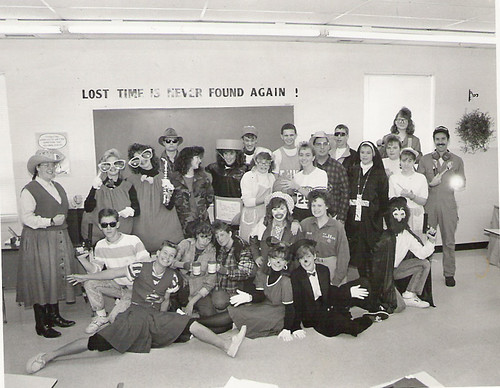
Can you find me?

Our junior class on dress-up day 1990
My junior year of high school during spirit week

Tuesday, November 30, 2010

Today ...


I was told I read extremist blogs so it's no wonder I have the wrong view of Islam.

Now I'm trying to figure out which of your blogs are the extreme ones!  :D


On Twitter, I saw this funny quote which Andrew and I both laughed about:

"What is the thinnest book in the world? Biographies of Happy women."


He wants to remember it to share with others.  :-)

Hope you are having a wonderful last day of November!  I haven't put up my Christmas tree yet.  I thought about doing it tonight, but they are talking about a possibility of severe storms with damaging winds (shudder!) and I'd hate to go to all the trouble of putting up the tree and decorations only to have my house destroyed and all that work be in vain. 

Samer told me today that I was a pessimist. Not about this, but about something else.  Maybe he is right.  :)

So, I read a good quote about emotions following our thoughts so we should be careful what we think about. So true.  I notice when I read certain books, they make me think a certain way and then my emotions often get angry, sad, irritated, disgusted and so forth. Can y'all tell I read today about a woman mistreated in a polygamous marriage? 

Actually the book (Nine Parts of Desire by Geraldine Brooks) isn't that bad.  I like many of the stories and found the tales of the women of the UAE being trained by American women soldiers very interesting!  The instructors said they had to revise their methods and started lavish praise for good behavior rather than harsh criticism of bad behavior.  "These women of the UAE," they said, "were raised to please" so they responded well to praise and not good at all to the harsh mannerism of military drill sergeants.

Speaking of our thinking influencing our emotions, I wonder if Paul had this in mind when he encouraged the Philippians this way:

 8 Finally, brothers and sisters, whatever is true, whatever is noble, whatever is right, whatever is pure, whatever is lovely, whatever is admirable—if anything is excellent or praiseworthy—think about such things.


If we fix our minds on God and how He has everything under control, we can have peace and joy even in tough circumstances. It's when we dwell on our problems that they seem to loom large, multiply and make us anxious and sad and fretful.

OK, so go have a wonderful December!


That's an order!  ;)


Drill Sgt. Susie signing off

*at ease*

Monday, November 29, 2010

Matthew 20:17-34 -- That Strange, Strange Jesus!

Continuing on in Matthew 20, we have Jesus predicting his death and resurrection. He told his disciples it was coming, but I suppose it was so, ummm, radical to talk about your own death and being raised to life, that they likely dismissed what he had to say or pondered it as just one of those eccentric things Jesus sometimes talked about.  Perhaps it was one of those parables he was so fond of that the disciples didn't always get at first listen.  Maybe they were too literal to "get" Jesus' more spiritual meaning.

Speaking of oddities, how about the moral at the end of this little exchange? I'll bold it for you. I want you to see this strange talk.


 20 Then the mother of Zebedee’s sons came to Jesus with her sons and, kneeling down, asked a favor of him.
   21 “What is it you want?” he asked.
   She said, “Grant that one of these two sons of mine may sit at your right and the other at your left in your kingdom.”
   22 “You don’t know what you are asking,” Jesus said to them. “Can you drink the cup I am going to drink?”
   “We can,” they answered.
 23 Jesus said to them, “You will indeed drink from my cup, but to sit at my right or left is not for me to grant. These places belong to those for whom they have been prepared by my Father.”
 24 When the ten heard about this, they were indignant with the two brothers. 25 Jesus called them together and said, “You know that the rulers of the Gentiles lord it over them, and their high officials exercise authority over them. 26 Not so with you. Instead, whoever wants to become great among you must be your servant, 27 and whoever wants to be first must be your slave— 28 just as the Son of Man did not come to be served, but to serve, and to give his life as a ransom for many.”


Jesus called attention to how the rulers of the Gentiles lorded over people, but he said "not so with you."  Jesus told them if they wanted to be great not to ask to sit at his right or left hand in his kingdom, but to serve others.  For Jesus, the way to be great was to serve!  Radical!

No wonder he is so great!

I also noticed from this how Jesus asked if the brothers were prepared to drink his cup (vs. 22) and then how he said they indeed would drink from his cup (v. 23).  That could be nothing but the way it was translated or a nit-picky thing I noticed during this reading, but still.  Jesus drank the cup, we drink from it.  Maybe only small sips or a gulp or two here and there. But he drank it all.  What does this cup represent to you? And drinking from it?


Don't you love how Jesus didn't come to be served, but to serve others!  He's so different from most leaders who want special privileges and exceptions to the rules. I respect people who lead by example.


The chapter ends with two blind men calling out for Jesus to restore their sight.  The crowd told them to hush, but instead they hollered louder.  Jesus stopped, asked what they wanted and when they asked for their sight,


 34 Jesus had compassion on them and touched their eyes. Immediately they received their sight and followed him.

I love this Jesus who can give sight to the blind and wants to serve others rather than be served! 


Thoughts?

Sunday, November 28, 2010

November Books & More Book Talk

I read so few books this month compared to most!  I did read, but I guess I just didn't finish as many. That Zachary Karabell one took so much time reading, writing notes, reading, writing notes...hehehe!  Plus we went on a short vacation and it was Thanksgiving and excuses, excuses.  I think I was busy reading all of YOUR blogs!  Did I ever tell you how much I learn from them?  :)

I went to the library yesterday and found a whole slew of books that I want to read.  I made a "master list" last night in my notebook of book, author, which local library and where they are located on the shelf. I think I have 15 or 20 books on that list!  Plus I added a few to my Amazon wishlist that people have recommended or else they were Amazon suggestions that seemed interesting. Can you believe until about three years ago I rarely read non-fiction books? I liked them when I read them on occasion, but I just mostly read Christian fiction. I guess now is my time to catch up on the non-fiction world.  It's soooo interesting!

I'm reading Nine Parts of Desire presently, but I doubt I'll finish it before the month ends since I just started it late last night.  I found it at the local library yesterday and it seems interesting although it's a bit old now.  So here is my short list for November. 


Children of Jihad by Jared Cohen -- see this post for more details

Peace Be Upon You: The Story of Muslim, Christian, and Jewish Coexistence by Zachary Karabell --see previous posts and here is the concluding notes

In this final chapter, the author spoke of the rise of fundamentalism yet challenged us all to remember there are still examples of Muslim, Christian and Jewish coexistence. He gave examples from not-too-far-in-the-past history like Jordan and Israel (although he said many Arabs believe the Jordanian kings to be Western pawns). He gave the example of Dubai and how it has taken capitalism global and built its society on people of all faiths and cultures working together.  He mentioned the Sawiris family of Egypt and the emir of Dubai as people who "are not trying to restore a golden age...not driven by a sense of grievance, ... [but] simply working with the world around them" trying to better the lives of themselves and their families.

He reminded us that this fundamentalism is not something we should project back into history as the way things have always been because as this book has shown, this simply is not true.  Fundamentalists have forgotten the "ecumenical spirit of the Abbasid court, the medieval philosophical tradition that celebrated interpretation and reason, the mystical traditions that emphasized God's love, and the relaxed attitudes toward People of the Book.... Instead, they imagined a time when Islam was the alpha and the omega, when everyone from the caliph to the slave imbibed the piety of the Quran and the tradition of the Prophet, and then in return, God graced his believers with power, fortune, and security."  (pg. 269)

Karabell notes that Jews, Muslims and Christians are all guilty of focusing on the conflict.  He noted that "each tends to paint the past as a series of indignities suffered at the hands of the other two."   Westerners often believe Muslim societies are "backward and intent on war and violence" whereas many Muslims "believe that the West bears ill will toward Islam and Muslims and wants not peace or coexistence but economic and cultural domination." (pg. 280)

He reminds us that "if conflict is what we want to see, there is conflict.  But if peace is what we are looking for, then peace is there to be found."  (pg. 285)


The Face Behind the Veil by Donna Gehrke-White -- see previous post


The Overton Window by Glenn Beck -- I saw this in the fiction new books section and decided to read it.  Not the most thrilling "thriller" I've ever read by far, but I could relate to the message of power corrupting people for sure!


What interesting books or topics have you been reading about lately?

Saturday, November 27, 2010

My View on Christian Rules

"Therefore if the Son makes you free, you shall be free indeed."

Sometimes in the course of "religious" discussions I've come across people who express a sense of amazement at how few rules and regulations there are in New Testament Christianity.  I'll say this up front that I am from more of a Protestant background so I can't speak of Tradition that Catholics and perhaps Orthodox Christians adhere to. Maybe the rules are in Tradition.  But for me, I tend to let the Bible be my guide. And while there are many wonderful aspects to the Old Testament - like examples of faithful men and women of God and the glorious promises of God in the Prophets and the Psalms written by David and others - I tend to base much of my life on the life of Jesus as described by his followers in the New Testament.


And, no, there are not a lot of rules.


In fact Jesus summed up all the Law and the Prophets with this: love God with all your heart, soul, mind and strength and love your neighbor as you love yourself.

And when asked who was considered a neighbor, Jesus gave the equivalent of the Israelis and Palestinians today by using a Samaritan man as the hero in a "Jewish story."  So, yes, even your enemy is considered your neighbor and Jesus said you need to love him or her like you love yourself.

Still people want guidelines.  What do we do in the case of divorce? What do we do in regards to inheritance rights for women?  What do we eat? What about this or that or the other situation here?

Most of the people who have expressed surprise - OK all of the ones - have been Muslims who are used to very detailed instructions on things they must do, things they must not do, suggested ways to do things and preferred ways to do things. I know I bring this up on occasion, but it's because I was so shocked when I first began studying more about Islam and saw they even had suggested ways to enter, use and clean yourself after using the bathroom.  Apparently the ahadith is chock full of rules and regulations so a Muslim used to such a way of life is appalled at the lack of direction we Christians must face!

Christ frees us from the weight of rules. We are free to love God and serve others!


You know how I think? 

God gives us principles for living in this world.  Some of us He put in restricted nations like China where in some areas you cannot worship God freely.  Some He put in free countries where we can worship or not worship God such as is the case in my own country.  For whatever reason, God put us in all kinds of countries with different levels of freedom. Do I think He wanted the believers in God who are scattered all over the globe to come together and make a nation called God's Country or Christendom or Islamostan?

Nope.

I think people have tried such things and failed!  Did Christianizing the Roman Empire bring Jesus' qualities of love for enemies and "going the extra mile" and "the greatest among you is the one who serves" to the people en masse?

We wish!

Instead it seems power corrupts. Whether that is "Christian" power or "Islamic" power or atheistic power, we have to guard against corruption.

I believe God wanted us to have His principles for living and then to live those out within the countries in which He placed us.  Society changes for the better when God changes hearts and lives not when we are made to wear certain clothes or not do this or that by legislation or police enforcing good morals. And for certain marching into other lands trying to change people's minds by sword or bombs is not the answer!

I still remember when I read Karen Armstrong's book and she said Muhammad cared about his family and friends in Mecca so he tried getting their attention by raiding their caravans.  This seems so bizarre!  You show you care by stealing from others?


For those from Europe marching into other lands: you try to convert the masses while at the same time you steal their natural resources?

For me, Jesus gave us guidelines on how to live.  He lived at a time when Palestine was occupied by Romans yet he never called for an uprising although a number of the Jewish people were ready for that.  This is one reason Jesus was rejected as Messiah! The Jews thought their Messiah was going to free Palestine from the occupying Romans.

But Jesus came instead with a message of love and turning back to God. It seemed he was more concerned with their spiritual states than the fact they were physically occupied by an infidel nation!

What?!

So no I don't have a list of rules telling me how much I can inherit, how many other wives my husband can take or even my rights in the case of divorce.  I live in the United States and my country has a number of rules covering such issues.  My spiritual role is to live like Jesus within my own country. 

And for you, the same.

One who loves doesn't need rules to tell him how to treat others.


Love God.  Love others.

Whether you are in the United States, Indonesia, Saudi Arabia, China, Britain or Venezuela.

If we love God and love others - and treat people like we want to be treated ourselves - just how many rules and regulations do we really need? 


"But the fruit of the Spirit is love, joy, peace, forbearance, kindness, goodness, faithfulness, gentleness and self-control. Against such things there is no law." (Gal 5:22,23)

Thoughts?

Friday, November 26, 2010

Matthew 20:1-16 -- The "Unfairness" of God

"It's not fair!"

"Life is just not fair!"

Have you ever heard these words before?  Maybe if you are like me, you've heard them come from your own mouth a time or two. Or maybe you've heard this from your child and had to give him or her the ol' "you're right so get over it" speech (or a variation of it) that I heard from my mom.

I can't explain or really understand why some people have good lots in life while others struggle merely to survive. Why some have the touch that makes most everything turn to gold while still others seem to be born losers. Why was I born in a country at a time where I don't have to struggle for my rights to vote, have a career or the freedom to express myself even if I'm critical of my own government and leaders?  I live in a nation where I can worship God freely, in a church and read my Bible without having to look over my shoulder to see if the police are coming to take it away because they hate what I believe God is saying to me.

I've read stories out of China where people in rural areas hide their Bibles because authorities there want to confiscate and burn these illegal books and imprison those who have them!  I can't imagine such an existence because I've always had freedom.  Likely I've even taken this freedom for granted wrongly believing it's the way most people in the world live.

Then I hear from my friends in Syria who can't legally access certain websites like Facebook, Blogger (this blog!!), YouTube and Amazon because that country wants to control its people or something!

Back to fairness, I was reading this passage in Matthew 20 and wanted to ask to whom you could most relate in these verses and what your thoughts were on this parable that Jesus told concerning what the kingdom of heaven is like.


1 “For the kingdom of heaven is like a landowner who went out early in the morning to hire workers for his vineyard. 2 He agreed to pay them a denarius [the usual daily wage for a day laborer] for the day and sent them into his vineyard.
   3 “About nine in the morning he went out and saw others standing in the marketplace doing nothing. 4 He told them, ‘You also go and work in my vineyard, and I will pay you whatever is right.’ 5 So they went.
   “He went out again about noon and about three in the afternoon and did the same thing. 6 About five in the afternoon he went out and found still others standing around. He asked them, ‘Why have you been standing here all day long doing nothing?’
   7 “‘Because no one has hired us,’ they answered.
   “He said to them, ‘You also go and work in my vineyard.’
   8 “When evening came, the owner of the vineyard said to his foreman, ‘Call the workers and pay them their wages, beginning with the last ones hired and going on to the first.’
   9 “The workers who were hired about five in the afternoon came and each received a denarius. 10 So when those came who were hired first, they expected to receive more. But each one of them also received a denarius. 11 When they received it, they began to grumble against the landowner. 12 ‘These who were hired last worked only one hour,’ they said, ‘and you have made them equal to us who have borne the burden of the work and the heat of the day.’
   13 “But he answered one of them, ‘I am not being unfair to you, friend. Didn’t you agree to work for a denarius? 14 Take your pay and go. I want to give the one who was hired last the same as I gave you. 15 Don’t I have the right to do what I want with my own money? Or are you envious because I am generous?’
   16 “So the last will be first, and the first will be last.”


Did you find yourself identifying with the workers who had been slaving away in the hot sun all day thinking they should have received more than those who had only worked one hour?  "It's not fair! We worked all day and these guys only worked an hour and you are paying them the same!"  Or were you OK with being paid the exact same since you agreed upon the usual daily wage and that is what your employee paid? It wasn't as if he broke his promise, right?  

Who will admit to being envious because the employee was generous and paid those who worked only 1 hour the same as those working 8 or 10 or 12?  Don't you think the employee was unfair for having paid everyone the same when some worked much harder and longer than others?

How does this parable relate to the kingdom of heaven since this is what Jesus said the whole point of it was?  And what does "so the last will be first, and the first will be last" mean? 

What lessons can we learn from this parable?  What "lessons" do you think the Chinese person who has to hide his faith might know from his situation that I might not know as one who has taken these freedoms for granted?  Do you see how in some ways he may have the advantage?  I daresay it makes a stronger believer if one realizes confiscation of property, torture and imprisonment are at stake for faith in Jesus Christ as opposed to one like me who believes in a nation that is favorable to Jesus.  Adversity tends to make stronger - more dedicated - believers. I admire my brothers and sisters in Christ who have faith in spite of opposition and unfairness.

Do you agree with how I titled this post? Do you believe this parable demonstrates the "unfairness" of God?  Do you agree that His "unfairness" can be a good thing? If you don't like the title, how would you rephrase it?


Thoughts on any of this?